A Suitcase, Sixty Years, and Every Word She Ever Sent Me: Painting the Family Archive
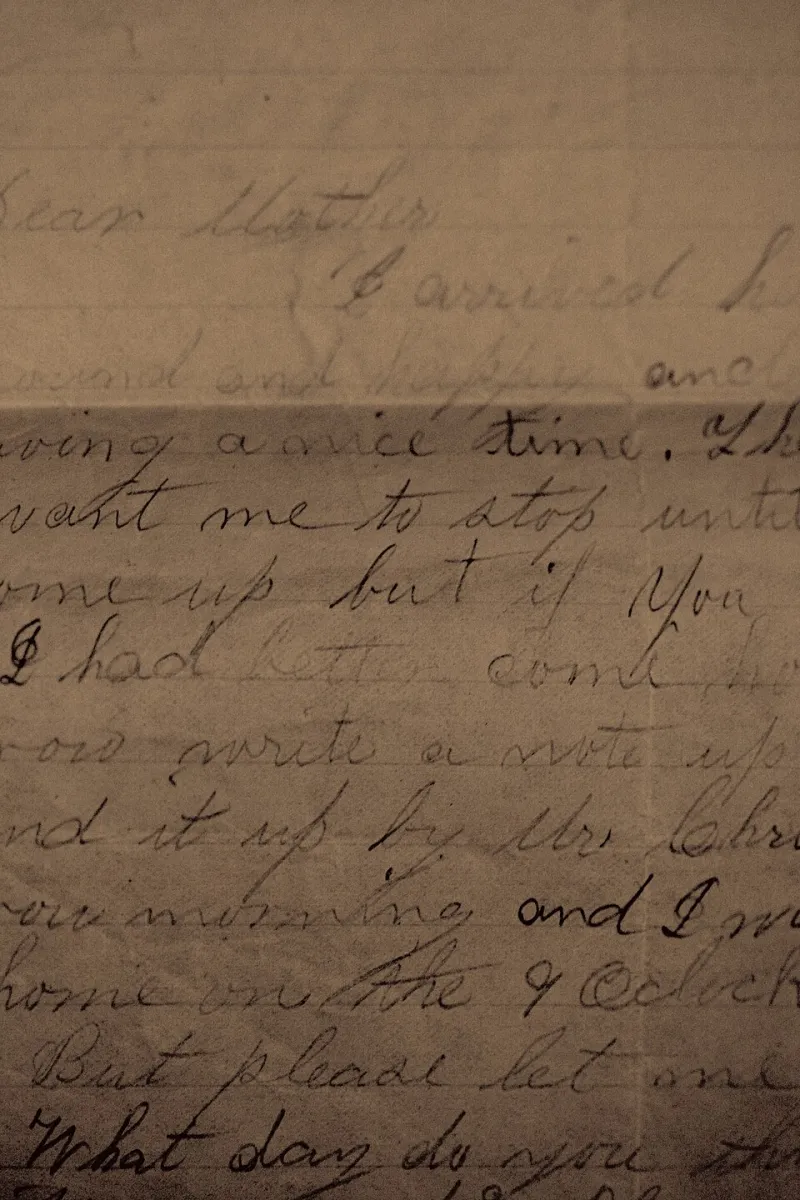
Photo: Pink Sherbet Photography from USA, CC BY 2.0, via Wikimedia Commons
The Suitcase Arrived Before I Was Ready for It
My grandmother's letters reached me in the least poetic way imaginable: a cardboard box, handed over by a cousin at a parking lot outside Boston, smelling faintly of cedar and old glue. Inside, wrapped in a towel, was the suitcase itself—thin leather, brass buckles seized shut, the kind of object that seems designed to carry a life and no more. It had crossed the Atlantic twice in its existence. The second crossing was for me.
I had known about the letters my whole life, the way you know about a relative you have never met. She wrote to her sister in Beirut for six decades. Air mail stickers, blue aerogrammes, the occasional photograph tucked between folds. When she died, the correspondence stayed with the family, then moved through a series of closets, and eventually became mine because I was the one who painted and no one else wanted the responsibility of throwing it away.
I want to be honest about what I felt, which was not immediate reverence. I felt dread. Dread of the obligation, dread of the handwriting, dread of the possibility that I would read them and find a woman I did not recognize.
Learning to Read a Hand
Her Arabic was the fluid, slightly old-fashioned hand of someone educated in the 1940s, and it took me weeks to read comfortably. The ink had shifted from black to a warm sepia in places, and on some aerogrammes it had ghosted through the paper so that every page carried a mirror of itself on the reverse. I began to understand the letters not only as language but as objects—paper that had aged, ink that had migrated, folds that had memorized themselves.
That was the turning point. I stopped trying to preserve the letters and started trying to translate them.
Translation, for a painter, means decisions about color and surface. I asked myself: what color is longing when it has been folded into eighths for forty years? What weight of line does a hand make when it is writing to someone it may never see again? The answers were not metaphorical. They were practical, and they arrived one by one in the studio.
From Document to Surface: What I Actually Did
For any artist holding a fragile family archive, here is the working method I arrived at, after several false starts:
- Scan everything before you touch it. High-resolution scans at 600 dpi, flatbed, unhinged. The scan is your working document; the original goes back in the dark. I painted from scans exclusively, which freed me from the terror of ruining something irreplaceable.
- Let the handwriting become texture, not text. In the early paintings, I tried to make the words legible, and the work turned illustrative. When I blurred, cropped, and enlarged the script until it became pure gesture—loops, baselines, the rhythm of a sentence without its meaning—the paintings came alive. Arabic script enlarged to the point of abstraction has a calligraphic architecture that rewards this treatment.
- Match pigment to paper. I ground my palette from the archive itself: the sepia of oxidized ink, the airmail blue of those border stripes, the buttery yellow of aged paper. I mixed these on-site from the scans under studio light. The result is a palette no photograph of the letters could have given me, because it is a palette of feeling verified against observation.
- Build the reverse-writing ghost. The ink that bled through each page haunted me. I transferred the script in reverse onto canvas using acrylic medium, so every painting carries a faint mirrored twin of its own surface—exactly as the letters did.
- Keep one fold visible. In every piece, I leave a crease: an actual pressed fold in the paper collage or a painted one. It is the archive's fingerprint, and I refuse to smooth it out.
Inheritance Is Not a Subject; It Is a Discipline
I worked on this series for two years, and somewhere in the middle I stopped thinking of it as a project about my grandmother. It became a practice about attention. Every morning I read one letter before painting, whether or not I used it. The reading tuned my hand. Her sentences were long, patient, unhurried by paragraph breaks, and my compositions loosened in response.
There is a particular American loneliness in receiving an archive like this—an immigrant's archive arriving in a New England parking lot, addressed to no one in particular. I have spoken with other artists here who hold similar boxes: Yiddish postcards, Vietnamese tapes, Korean ledgers. We are all translating. The materials differ; the discipline of listening does not.
The suitcase sits in my studio now, open, empty, buckles finally unjammed. It holds nothing, which is another way of saying it holds everything, because the paintings on the wall are where the letters live now—in cobalt and sepia, folded and unfolded, legible and gloriously not.