What the Studio Wall Knows: Five Hard-Won Rules for Knowing When a Painting Is Finished
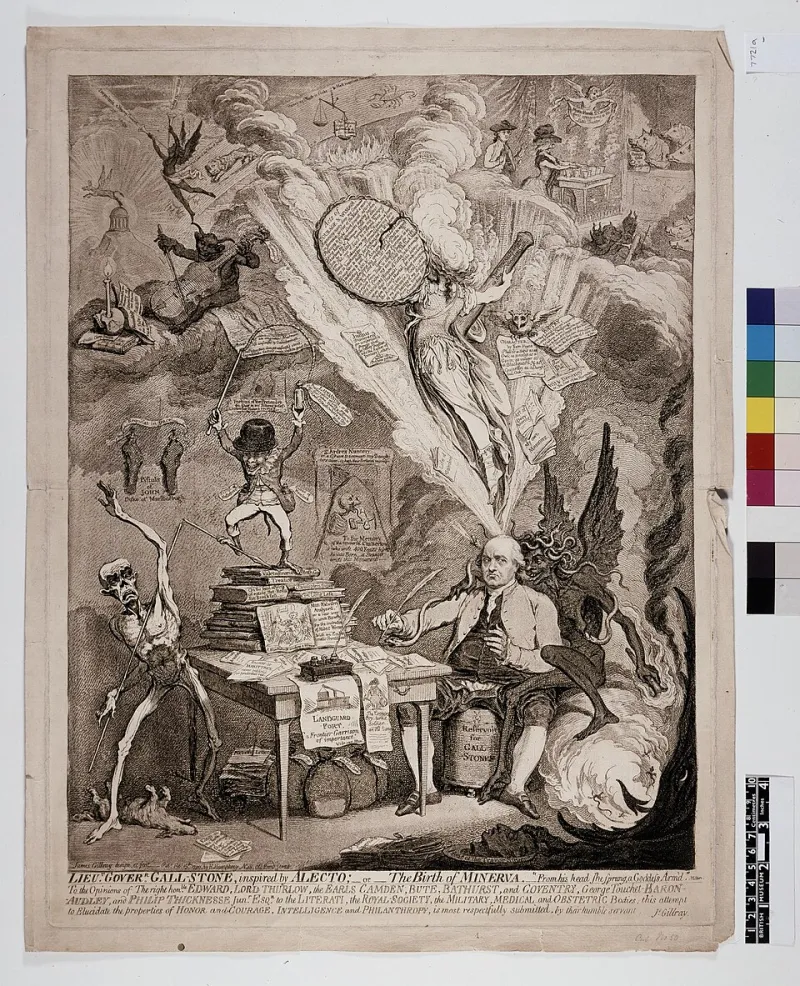
Photo: Print made by: James Gillray Published by: Hannah Humphrey, Public domain, via Wikimedia Commons
The Wall as Collaborator
In my studio, there is a stretch of wall beneath the north-facing window that I have never painted over, never covered with shelving, never allowed to accumulate the usual debris of a working space. It holds perhaps three canvases at a time, leaning at a slight angle, catching the even, shadowless light that American painters have prized since the days of the Cape Cod studios.
I call it the wall, but it functions more like a colleague. Paintings go there when I suspect they are finished — and the wall, unlike me, has no ego invested in the outcome. Over the years it has taught me five lessons I now consider foundational to my practice.
Lesson One: The Wall Reveals What Momentum Hid
Every painting is made in motion. You step back, you step forward, you adjust, and the adjustments accumulate faster than your judgment can audit them. The moment you stop, momentum is still in your eyes.
The wall's first gift is time. A canvas that looked resolved at 6 p.m. may look lopsided at 9 a.m., when you have come in for coffee and forgotten, briefly, that you were judging anything. That forgetting is the point. Actionable rule: never declare a painting finished on the day you last touched it. Give it one full night. Preferably one that includes a day of working on something else entirely.
Lesson Two: If You Keep Finding Excuses Not to Look, the Painting Is Talking
There is a particular avoidance I learned to recognize: walking into the studio and arranging everything — brushes, emails, the radio — before turning toward the wall. When I catch myself doing this, the canvas is usually telling me something I do not want to hear.
Sometimes the message is I am unfinished. More often, and more painfully, it is I am not working, and more paint will not save me. Learning to hear the difference took me years.
Lesson Three: Overworking Is Usually Fear in Disguise
I once spent eleven months on a portrait that needed, by the honest assessment of any stranger walking past, about three weeks. Each additional session felt productive; each one drained a little more life from the surface. I was not refining. I was postponing the vulnerability of calling it done — because a finished painting can be rejected, while an unfinished one is safely hypothetical.
Actionable rule: when you feel the urge to add a fifteenth layer, photograph the painting and look at the image on your phone. The small version strips away texture and reveals structure. If the small version is already strong, stop. If it is weak, more paint rarely fixes it — the problem is compositional, and you will need to scrape back, not build up.
Lesson Four: Abandonment Is a Decision, Not a Failure
Not every canvas earns completion. I keep a stack of works on panels that I now call, without apology, my education — paintings that taught me something specific and then had the decency to stop pretending they would become anything else.
The wall taught me this: a painting that still bothers you after a month of honest attention is often not stuck but finished in its failure. Gesso over it. Cut it up. Paint the back. The lesson was the payment; you do not owe the canvas further labor.
What abandonment is not is the same as a resting period. A painting that returns from six weeks on the wall with new possibilities is on a pause. A painting you have circled for six weeks, touching and retouching the same corner, is finished in the only way it will ever be.
Lesson Five: Build a Ritual for the Verdict
Eventually I formalized my relationship with the wall, and I recommend something similar to any emerging artist struggling with the finish line:
- The overnight test: every candidate for completion spends one night on the wall before any signature.
- The squint check: viewed blurred, from across the room, does the painting hold together?
- The one-question audit: Is there anything this painting needs, or only things I want to do to it? Needs get addressed. Wants go to the next canvas.
- The calendar: any piece lingering unresolved for more than two months gets a written verdict — finish, rework, or retire — in my studio notebook. Writing it down ends the limbo.
The Wall Is Always Right
I have come to trust that stretch of painted plaster more than any critique I have received, generous as those critiques were. The wall does not flatter, does not tire of my company, and does not care whether the painting took three days or three years.
If your studio lacks one, make one: a clean, well-lit stretch of nothing where finished and nearly-finished work can sit in the light and be seen plainly. Then do the hardest, simplest thing in this profession — listen to it.