The Words Stay Behind at Customs: On Painting in My Mother's Grammar
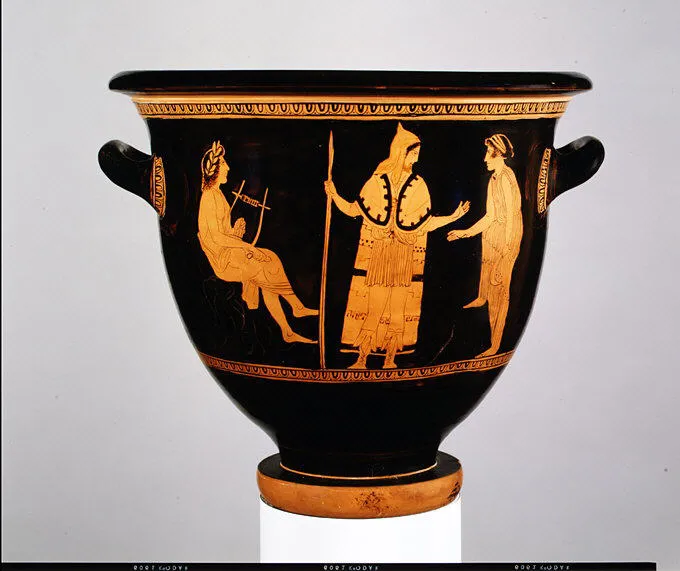
Photo: Creator:Painter of London E 497, CC0, via Wikimedia Commons
My grandmother spoke in a chain of images. If she disapproved of a neighbor, she did not say so; she said the wind had turned on that street. If she loved you, the sky had opened. When she died in Beirut, I was in a studio in Ohio with a lexicon of English so large and so useless that all I could produce was a grocery list. I sat down that evening and mixed the color of her sayings instead. It was a green I had never sold and never repeated — too warm for pine, too sick for jade. It was the wind turning on a street.
Two Languages, Neither Willing
I grew up trilingual in the way many children of diaspora do: fluently at home, functionally at school, and privately in both. Arabic held the family, the recipes, the insults, the tenderness. English held the report cards and, eventually, the exhibitions. Between them ran a border checkpoint where meaning was routinely searched and something always confiscated.
There is a word for the ache of this — alghanīma, roughly, what the raid leaves behind — but the word itself is a casualty. In English I can explain that I miss the sea. I cannot explain that in Arabic the sea is grammatically masculine and therefore capable, in my family's idiom, of betrayal. The syntax does the feeling. Translation kills it politely.
What the Audience Asks
American galleries, in my experience, want the work to explain itself in a wall text of reasonable length. They want the story legible: war, migration, resilience, a red thread. And I understand the request. But so much of what I paint is not about anything in the translatable sense. It is about how my mother pronounces the letter 'ain' — a sound English throats cannot make, a constriction like grief held politely in the back of the mouth. When I paint, I am doing phonetics in pigment. A viewer who has never heard the letter can still feel the constriction in the composition: the way forms press against the edge of the canvas and refuse to resolve.
I have stopped apologizing for the opacity. A painting that explains itself in English has already agreed to a smaller citizenship.
The Grammar of Color
Every language sorts the world differently, and mine sorts it by color in ways English finds excessive. We have practical names for the blue of doors against whitewash, for the specific oxidation of copper in harbor air. In the studio, I have come to treat these names as a grammar: the cobalt is a subject, the oxide a verb, and the composition a sentence whose word order — verb first, the way Arabic often runs — produces a logic English viewers register as 'tension' or 'urgency' without knowing why.
This is not mysticism. It is simply that I learned to see before I learned to translate, and the seeing was done in one language while the selling is done in another.
What I Tell Students Now
When a student tells me they feel their 'real' language slipping — that they dream in one tongue and defend a thesis in another — I tell them the slip is the material. The gap is not a defect to be sanded smooth; it is the negative space the work lives in. Paint from the checkpoint. Paint the confiscated suitcase. Paint the word that has no equivalent and do not caption it.
My grandmother's green hangs now in a collector's stairwell in Chicago. At the opening, a woman stood before it a long time and said, 'I don't know why, but this feels like my mother's kitchen.' I did not tell her the color's history. Some sentences survive the border only if no one declares them.