Seven Kitchens, Seven Radiators, One Body of Work
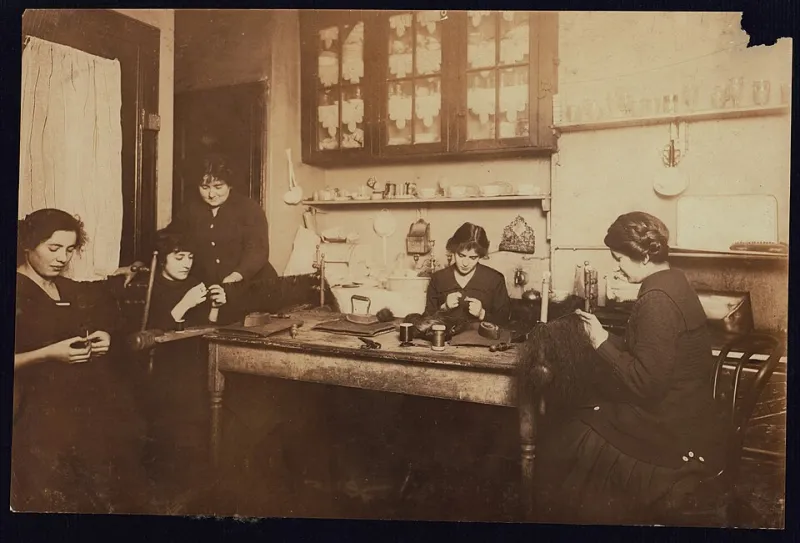
Photo: Hine, Lewis Wickes; National Child Labor Committee Collection, Public domain, via Wikimedia Commons
I have been keeping a ledger I never intended to keep. Not of sales or gallery contacts, but of apartments. Seven of them, in twenty years, scattered from Providence to Oakland. Each one appears in the work — not as subject, exactly, but as condition. The paintings know where they were made, even if the viewer never will.
The Radiator in Providence
The first studio-apartment I rented in America had a cast-iron radiator that hissed all winter like something learning to speak. I painted beside it for two years, and I am convinced the work from that period is warmer than anything I made before or since. Not warmer in temperature — warmer in palette. The ochres deepened. The whites went cream. I blamed it on taste until I realized I was simply painting what the room gave me: the amber glow of steam heat at 6 p.m. in a third-floor walk-up on Benefit Street.
Light is the first landlord. It sets the terms before you unpack a single tube of paint.
The Kitchen Table Years
The second apartment, in Somerville, Massachusetts, had no room for an easel. I painted at the kitchen table for three years, wedging canvases against the refrigerator between meals. People romanticize this now — the kitchen table studio — but let me be honest: it was a discipline I did not choose. I learned to paint in ninety-minute increments, the length of time between a school pickup and a dinner I had promised to make.
The paintings got smaller. They got faster. They got, oddly, more decisive. A canvas you must clear by five o'clock does not permit the luxury of endless revision. Some of the best decisions of my career were made under the tyranny of a dinner deadline.
What Temporary Rooms Teach
When I moved to Chicago — apartment four, a garden unit with northern light that never quite arrived — I made a rule that has governed every studio since: paint the room you have, not the room you want.
The practical version of this rule looks like this:
- Choose materials to match the square footage. Watercolor and gouache flourished in apartments where oil paint and its solvents would have been a lease violation.
- Let the walls stay white. I stopped repainting rentals and started letting the existing walls act as my neutral ground. Every landlord's eggshell became my studio gray.
- Store vertically. A narrow closet, properly shelved, holds forty stretched canvases. I have measured.
- Make one work at a time. Small rooms punish ambition that exceeds their walls. The constraint became a style.
The Neighbor Clause
No essay about apartments is honest without mentioning the people on the other side of the wall.
In Oakland, apartment six, my downstairs neighbor was a retired machinist named Ray who could hear my chair scrape and, apparently, cared. We negotiated a schedule — no scraping before nine — and in exchange he never once complained about the smell of linseed oil drifting down his stairwell. Ray appears, unbilled, in a series of paintings about proximity: figures seen through doorways, shoulders half-turned. I was painting the wall between us the entire time.
The radiator hisses. The upstairs footsteps cross the ceiling at eleven. The neighbor's television murmurs through the plaster. All of it goes into the work. A painting made in solitude is a fiction; every painting is made in company.
Owning the Look of a Rented Life
For years I resented the way these rooms dictated my output. I wanted to believe the work descended from pure intention — that I chose the palette, the scale, the mood. The truth is more collaborative and, I have come to think, more interesting. My paintings are portraits of my housing history. The Providence warmth, the Somerville compression, the Chicago gray: they are all in there, layered like the paint itself.
I do not own a studio in the romantic sense. I have never had the barn, the warehouse, the skylight. What I have had is seven kitchens, seven radiators, seven sets of neighbors, and a stubborn refusal to wait for perfect conditions that were never coming.
The eighth apartment is a house, finally — our first. The light is generous and the room is mine. I have been here a year now, and I will tell you what nobody warns you about: with nothing left to constrain you, you must invent your own discipline. The rooms taught me everything. Now the work is to prove I learned.