Grinding Toward the Unspeakable Hue: A Year at the Mortar and Pestle
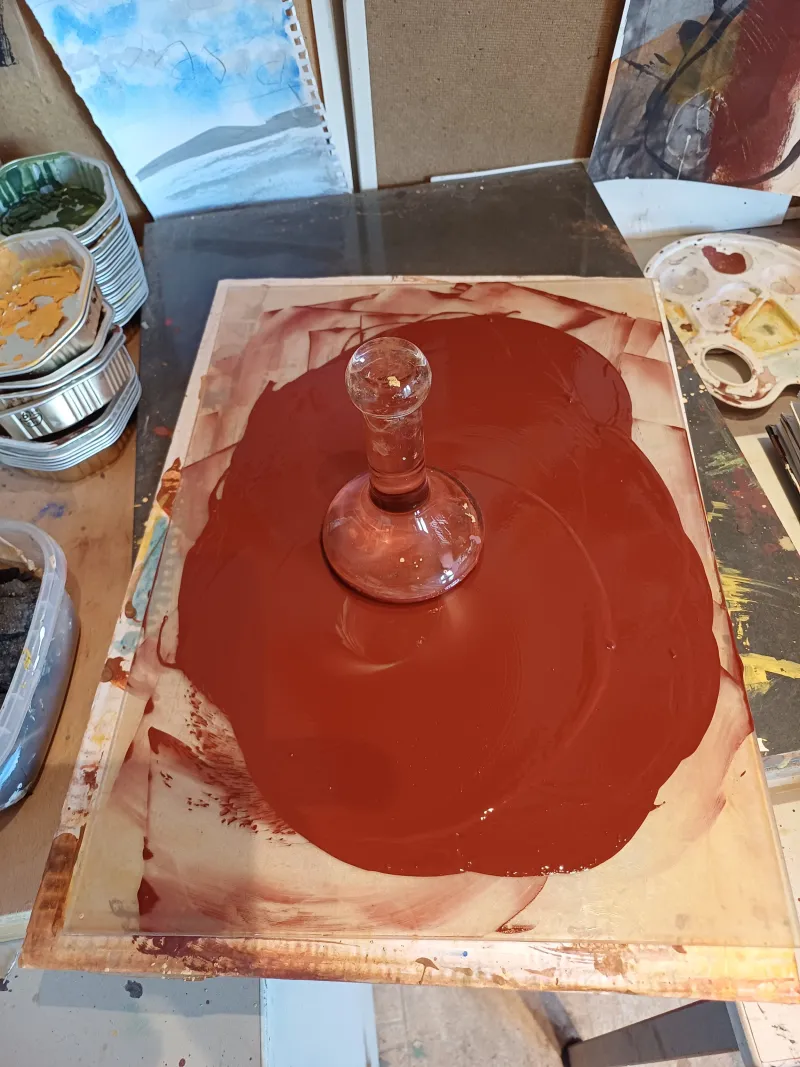
Photo: hand grinding pigment with glass muller on slab artist studio, via images.squarespace-cdn.com
The Premise, Stated Plainly
Every color you have ever bought comes from somewhere, and almost none of those somewheres are places you've been. Titanium white from a mine in one hemisphere. Phthalocyanine blue synthesized in a New Jersey lab sometime in the last century. The tube is a small act of concealment: it hands you the result and withholds the history.
So I set myself a twelve-month discipline. One evening a week, at a folding table in the studio, I would make paint the old way — dry pigment, binder, glass muller, slab. And I would chase one specific, possibly impossible target: a color I could not find in any tube, match on any screen, or point to in any commercial swatch book. Call it a private grudge against the standardization of seeing.
What Paint Actually Is
A primer, for the curious, because the mechanics are more interesting than the mystique. Paint is two things: a pigment (the powdered colorant — mineral, earth, or synthesized chemical) and a binder (the stuff that makes it stick — linseed oil for oil paint, gum arabic for watercolor, acrylic polymer for the plastic-based paints most of America paints with).
Grinding is not crushing. The particle of pigment must be broken down and dispersed — evenly suspended in the binder so every molecule is wetted. Under-grind and the paint crumbles; over-grind some pigments and you actually dull them, because a particle's size changes how it scatters light. Cobalt, for instance, wants a coarse grain to stay luminous. Learn that by doing it wrong once and you will never forget it.
My tools were modest: a stone muller, a slab of tempered glass, jars of linseed oil of varying refinement, a respirator I bought after reading about cadmium toxicity and wearing a dust mask that turned out to be decorative.
A Partial Catalog of Failures
The year is best told through what did not work.
Month two: the red clay that lied. A gorgeous raw sienna dug, with permission, from a friend's land in upstate New York. In powder form it was breathtaking. In oil it went muddy, brown, forgettable. Lesson: a pigment's character is only fully revealed in its vehicle. Earth colors are shy in powder and honest in oil — or the reverse.
Month five: the muller versus the mica. I spent six weeks on a pearlescent ground made from mica scrap, chasing a shimmer I'd seen on the surface of a lake in Maine at dusk. The particles kept clumping. Adding more oil made a paste like toothpaste. I eventually got a single successful batch — and it was, admittedly, lovely: a gray that moved when you tilted your head.
Month nine: the green that exists only at 7 p.m. This was the closest I came to the goal. A blend of a synthetic viridian with a trace of my own ground ochres produced a green that shifted, under tungsten light, into something I can only describe as incoming. Not teal, not olive. The problem — the instructive problem — is that it only behaves that way under one light source, at one hour, in one room. Which is to say: it may be that the color I was chasing was never a pigment at all. It was a set of conditions.
The Impossibility, Confirmed and Appreciated
Here is the materials-science punchline that took me most of the year to accept. A color that no screen can replicate is trivially easy — screens render a limited gamut and any saturated pigment outside it defeats them. But a color that no light conditions, no surface, and no viewer's eye can pin down is a different matter. Color is not a property of paint. It is an event — pigment, light, and retina agreeing, briefly, on something.
So the year didn't give me an unspeakable hue. It gave me something better: a permanent suspicion of the flat, and a habit of asking where every color in my studio came from, who ground it, and what it looked like before anyone put it in a tube.
The muller still sits on the folding table. I use it every week now, not to invent a color, but to keep faith with the ones I have.