The Hum Behind the Whites: Six Colors From the American Laundromat at Nine
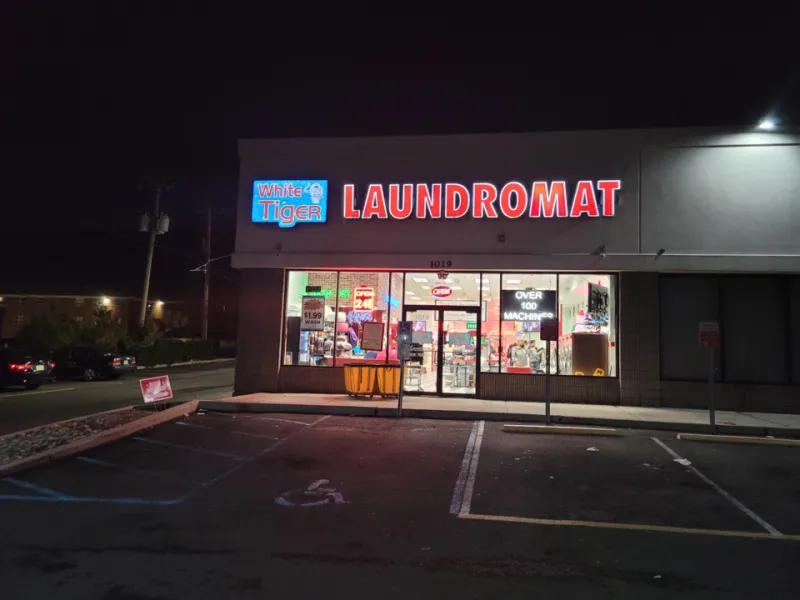
Photo: Curlyrnd, CC BY-SA 4.0, via Wikimedia Commons
The first thing I notice at nine o'clock is not the laundry. It is the hum. Fluorescent tubes overhead do not simply illuminate a laundromat; they tint it. They pull the room toward green, then toward pink, then toward a tired institutional white that no paint chip can honestly reproduce. Over the past year, I have visited laundromats in South Philadelphia, East Austin, Fresno, Queens, and a strip-mall stretch outside Cleveland. I went at night because night is when these rooms stop performing efficiency and start telling the truth. I kept a chart. It was not a sentimental exercise. It was a civic one.
Tube White, Which Is Never One White
The laundromat white is a family, not a color. Under one bank of tubes, a folded towel looks chalky and blue. Under another, the same towel turns faintly rose. Near the change machine, where the light is older, the white goes yellow at the edges, as if the room has been holding its breath since the 1990s. I began mixing these whites on small boards: tube white with a little viridian, tube white with a little alizarin, tube white with the gray that settles into a room after too many cycles. The result is a palette that feels less like cleanliness than like endurance. A laundromat at nine is not a showroom. It is a place where people bring the evidence of their lives and ask a machine to make it bearable.
Detergent-Cap Blue, Bruised and Otherwise
The blues are the most articulate colors in the room. There is the bright royal blue of a national brand, the powdery blue of a discount detergent, the near-black blue of a cap that has rolled under a folding table and stayed there. These caps accumulate in corners like small, accidental still lifes. I have painted them as I found them: scuffed, dusted with lint, sometimes filled with a residue that has dried into a chalky ring. The blues are not decorative. They are a register of household budgets. A large jug with a measuring cup speaks differently from a small bottle bought at a corner store. The color is the same family, but the wear is not.
Out-of-Order Yellow, Taped and Re-taped
The out-of-order signs are almost always yellow, and almost always taped over an older yellow sign. The tape goes amber with age. The marker bleeds. One sign in Queens had been repaired so many times that the yellow had become a kind of geological record: lemon tape, mustard tape, a pale scrap of paper, a black arrow pointing at a machine that had clearly been broken longer than anyone cared to remember. I do not read these yellows as warning. I read them as exhaustion. They are the color of a room managed by someone who is doing their best with what is left.
The Single Sock Red
There is usually one sock. It is usually bright. It sits on a folding table, or under a plastic chair, or draped over the rim of a hamper as if it has just stepped away. The red is not always red; sometimes it is a hot pink, a coral, a safety orange. But it behaves like red in a painting: it pulls the eye across the room and makes everything around it look quieter. I have come to think of the lost sock as a small monument to the fact that no system is complete. A community can run its machines, sort its darks from its lights, and still leave something behind.
Lint Gray and the Floor That Remembers
The floor is the color most people forget. It is a gray that is never pure, because lint, dust, and street salt have been walked into it for years. In one Fresno laundromat, the floor was a pale speckled vinyl that had gone the color of old mop water around the machines. In another, the tile was a deep charcoal that made the lint look like snow. I began photographing the floor before I photographed the machines. The gray told me who cleaned the room, how often, and whether anyone was expected to notice.
Parking-Lot Black
The windows turn black after nine. The glass stops being a window and becomes a mirror. You see your own reflection standing among the dryers, and beyond it, the parking lot with its one sodium light and its rows of empty cars. That black is not empty. It holds the room's second palette: the reflected whites, the detergent blues, the single red sock. When I left each laundromat, I wrote down the colors I had seen and the ones I had missed. The chart is not a catalog of poverty or nostalgia. It is a record of routine, and of the colors a community wears when it believes no one is looking. The hum stays with me longer than the laundry does.